

New Study Shows Project Labor Agreements Reduce Cost & Provide Efficiency
 For New Jersey taxpayers, the question surrounding major public construction projects is straightforward: How can the public entities build schools, infrastructure, roads and facilities faster, more efficiently and with greater certainty that the projects stay on budget?
A new study commissioned by the Engineers Labor-Employer Cooperative (ELEC 825) suggests that Project Labor Agreements (PLAs) can be an important part of the answer. This comes as a new state law signed earlier this year expands access to optional project labor agreements for NJ municipalities, counties and school districts.
A Project Labor Agreement is a pre‑hire contract for a construction job that sets wages, benefits, work rules, training standards, and no‑strike conditions for all contractors. It aims to stabilize labor, reduce delays, and ensure consistent jobsite practices.
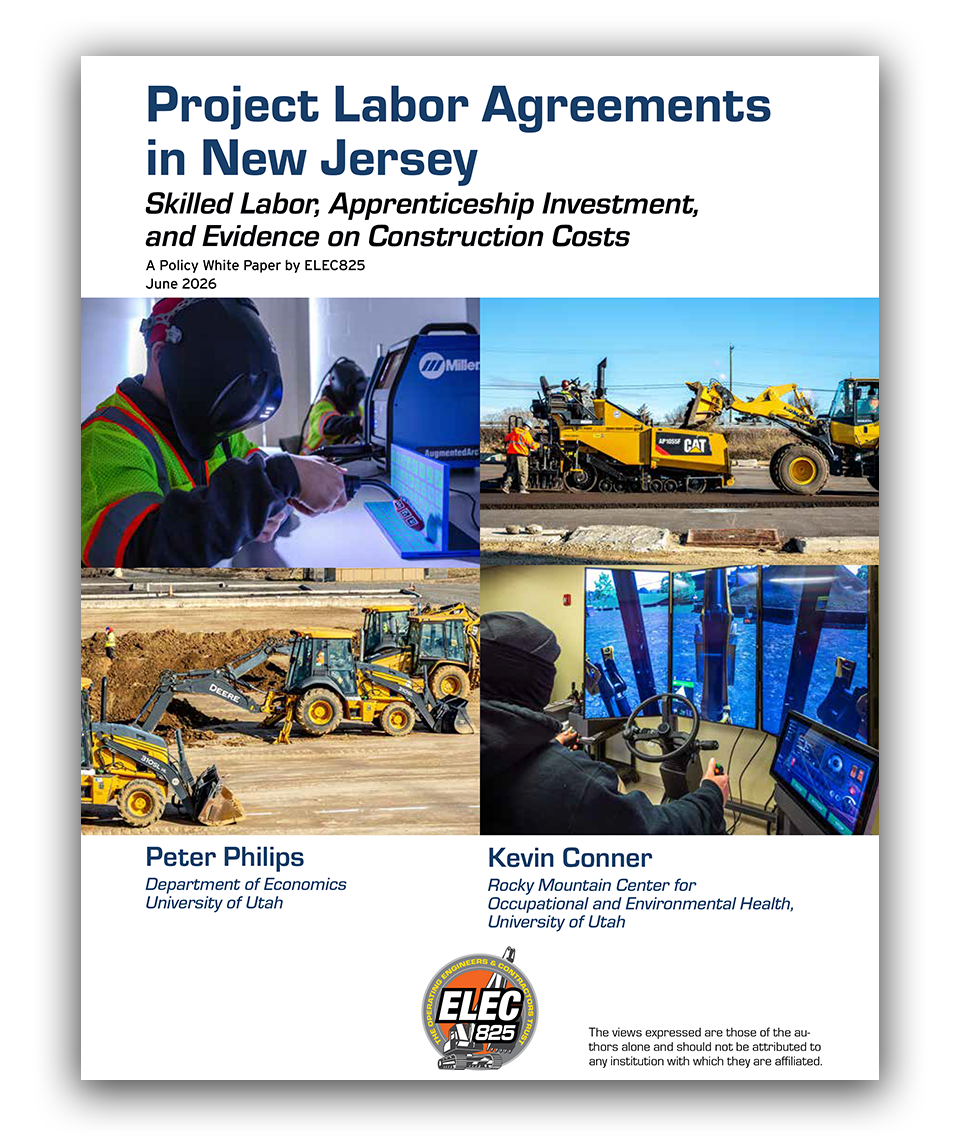
The 2026 white paper, Project Labor Agreements in New Jersey: Skilled Labor, Apprenticeship Investment, and Evidence on Construction Costs, was authored by Peter Philips, a professor of economics at the University of Utah whose research specializes in the construction industry, and Kevin Conner, a labor economist and postdoctoral researcher at the University of Utah. The study examines New Jersey’s construction workforce, apprenticeship investment and the evidence surrounding the cost and performance of projects built under PLAs.
The report’s central conclusion debunks long-standing and misinformed criticisms of Project Labor Agreements and concludes that PLAs do not make public construction more expensive.
In fact, the researchers found that the evidence used to claim PLAs are more expensive – particularly a 2010 New Jersey Labor Commissioner study – has significant methodological limitations that lead to a false narrative. When those limitations are addressed, the apparent cost difference between PLA and non-PLA projects becomes substantially smaller and, among the most comparable projects, disappears.
The real cost of construction isn’t just the bid
Construction costs are more than the number written on the winning bid.
A project that is delayed for weeks or months can impose substantial additional costs on taxpayers, owners and the communities waiting for the facility to open. Delays can result in extended project-management costs, inflation, financing expenses, change orders and lost use of the completed facility.
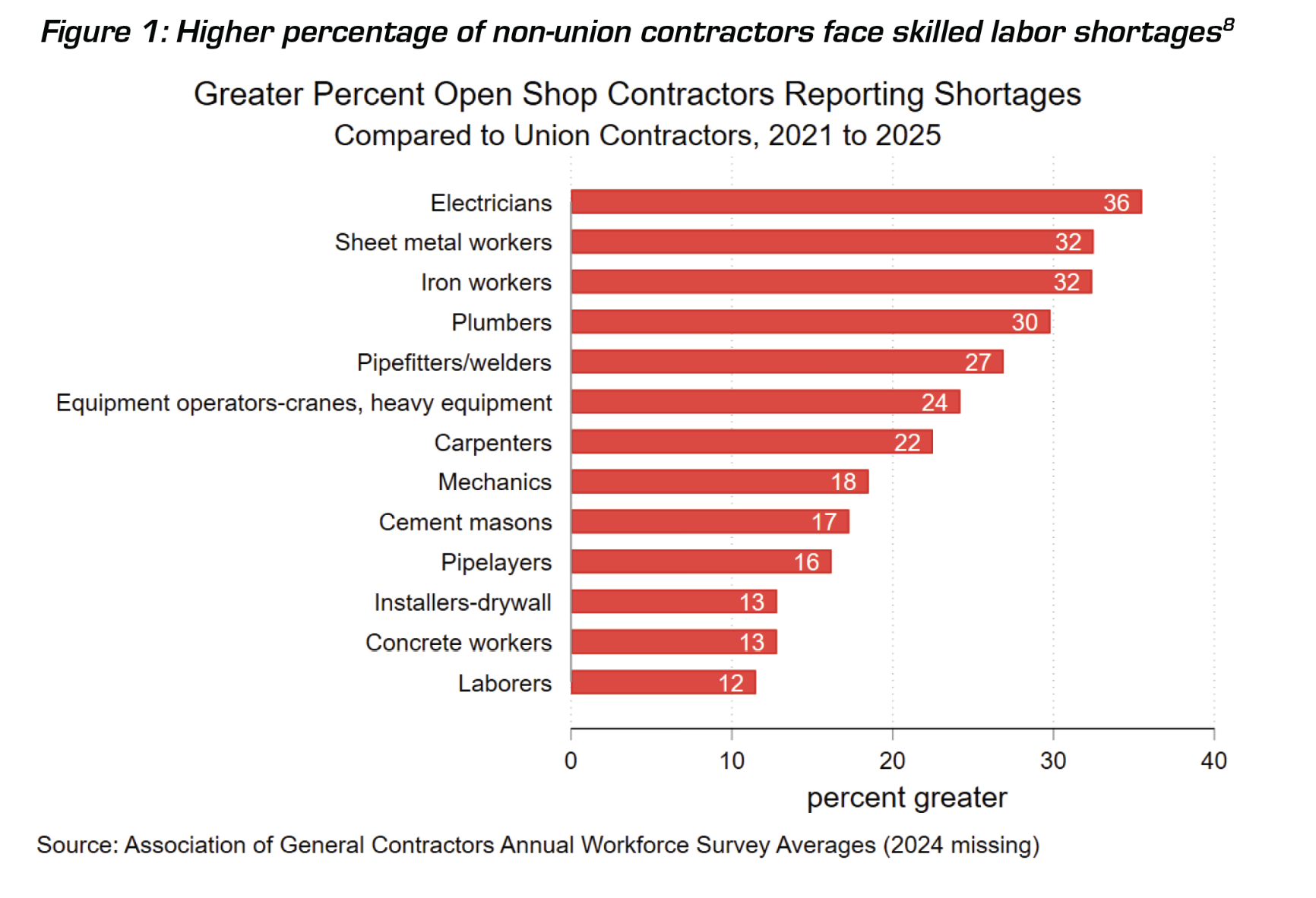
New Jersey’s non-union construction industry is facing a significant skilled-worker shortage.
According to the white paper, 73% of New Jersey contractors surveyed in 2025 reported severe difficulty finding qualified workers, and it took an average of 71 days to fill an open position. However there was a measurable difference between contractors signed with union apprenticeship programs and those that were not: on average there was a 25% difference and in some cases the shortage differences neared 40%. (ELEC 825)
PLAs provide access to a larger skilled workforce
A Project Labor Agreement establishes the terms and conditions under which construction work will be performed before a project begins.
Among other provisions, PLAs provide access to union hiring halls, establish standardized work rules and dispute-resolution procedures, and generally include no-strike and no-work-stoppage provisions.
Importantly, the study notes that PLAs do not necessarily exclude non-union contractors. Non-union contractors can bid on PLA projects and can bring key employees with them while also accessing additional skilled workers through union hiring halls when necessary.
For a public owner, that creates a potentially valuable combination: competition among contractors coupled with access to a broader pool of trained workers.
The researchers describe this as providing public projects with access to skilled labor from both the union and non-union segments of the construction industry. (ELEC 825)
The workforce investment matters
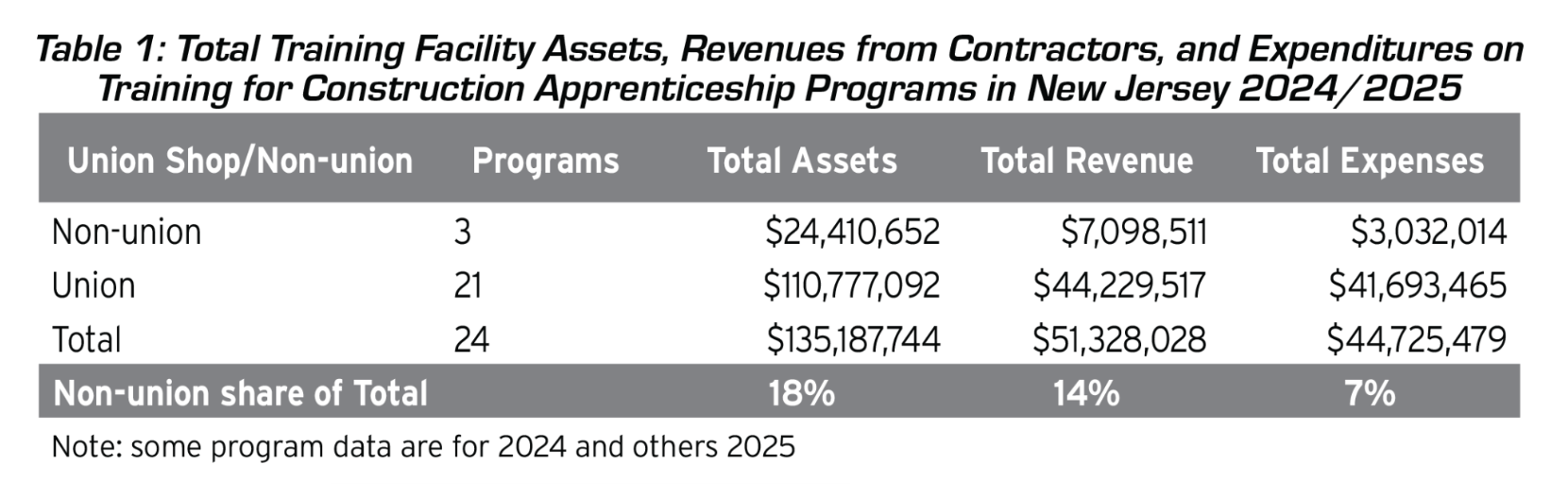
One of the study’s most significant findings concerns apprenticeship training. New Jersey has 24 registered construction apprenticeship programs representing approximately $135 million in training-facility assets. According to the study, 21 union programs account for approximately 82% of the value of those facilities and the overwhelming majority of reported apprenticeship expenditures. (ELEC 825)
The researchers argue that this investment matters because construction is a project-based industry. Individual contractors may have limited incentive to make large investments in training when a worker can leave for another contractor once a project ends.
Union apprenticeship programs address that problem by spreading training costs across participating contractors through collectively bargained contributions.
The result is an industry-wide workforce investment rather than an investment that falls entirely on an individual contractor.
That distinction becomes particularly important as New Jersey prepares for an enormous wave of infrastructure, energy, transportation and building construction.
Training today can mean fewer delays tomorrow
The white paper points to a connection between workforce development and project efficiency.
Skilled workers are particularly important on a project’s critical path – the sequence of tasks that determines when a project can ultimately be completed. When a critical trade is short of workers, the delay can cascade into other portions of the project.
An inexperienced worker can also create additional problems through slower production, rework or construction defects.
Conversely, a reliable supply of trained workers allows contractors to maintain workflow, coordinate crews and keep critical-path activities moving.
This is where the researchers argue that the value of a PLA should not be judged solely by comparing the initial construction bids.
A project that costs slightly more – or no more – to bid but is completed sooner and with fewer disruptions ultimately represents the better value for taxpayers.
Rethinking the 2010 cost argument
For years, critics of PLAs in New Jersey have pointed to a 2010 study by the state’s Labor Commissioner that found PLA school construction projects appeared to cost approximately 19% more per square foot.
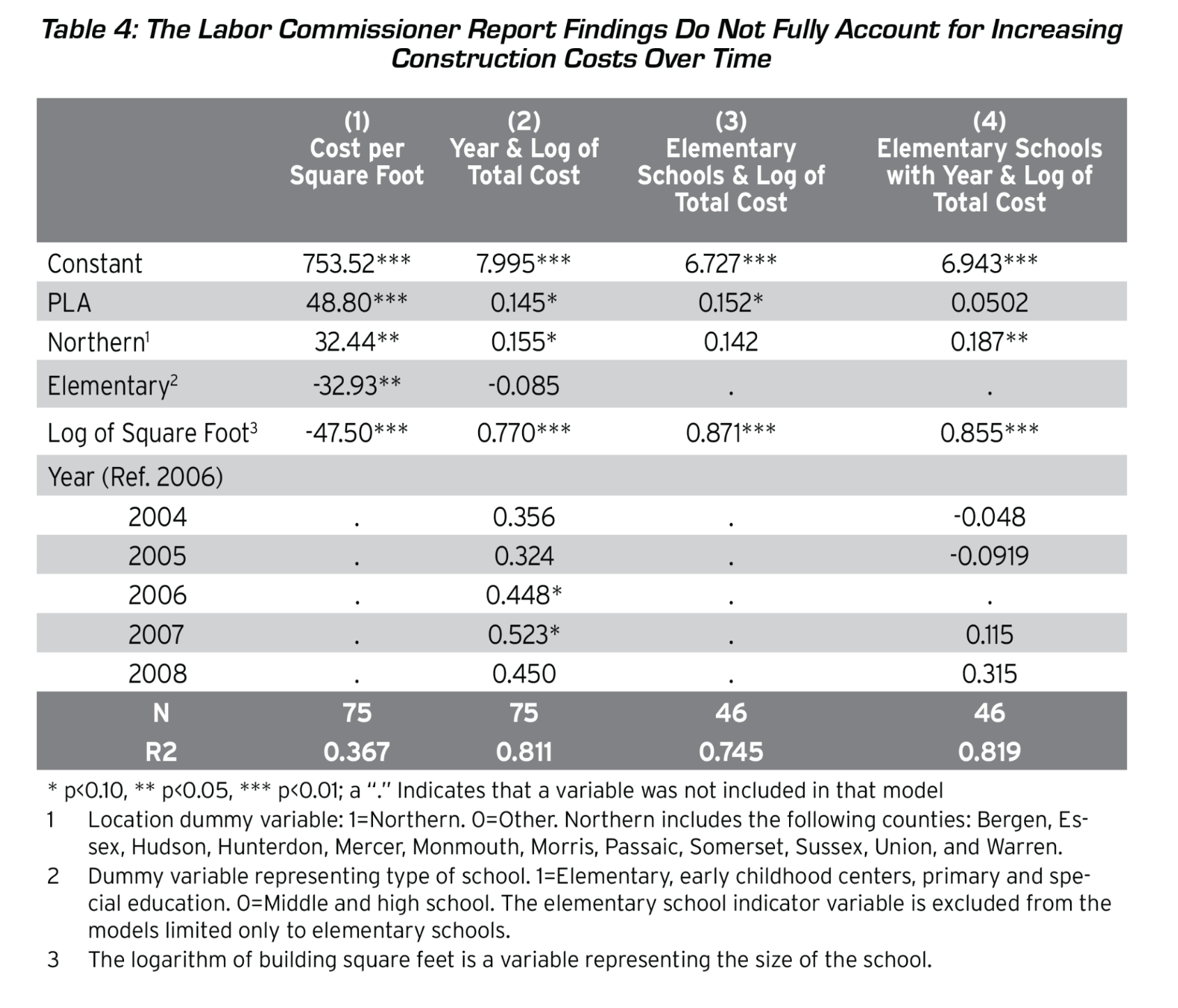
A fresh look at this study by researchers has concluded that the 2010 study does not provide reliable evidence that PLAs inherently increase New Jersey public construction costs. There were several major methodological problems identified, including the way square footage was incorporated into the statistical model and the difficulty of adequately accounting for rapidly changing construction costs during the period studied.
Most significantly, the timing of PLA and non-PLA projects was different. Non-PLA projects in the data were concentrated earlier in the period, while PLA projects were disproportionately completed later—when construction costs were rising significantly.
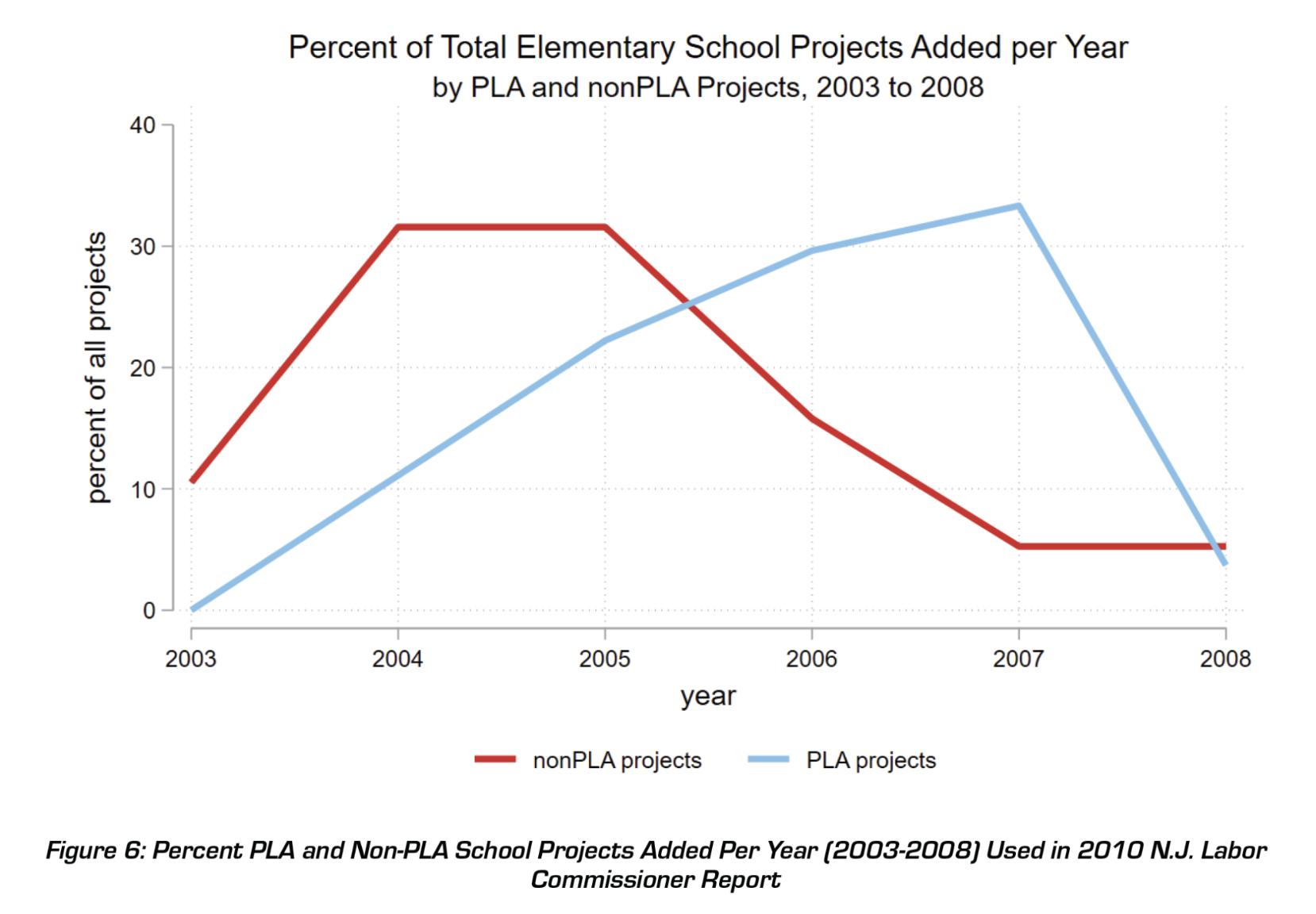
In other words, the original analysis risked attributing some of the increased cost associated with when a project was built to whether the project used a PLA.
After modifying the analysis to better account for changes in construction costs over time, the researchers found a substantially smaller association between PLAs and project costs. In a model limited to elementary schools and controlling more fully for timing and project characteristics, the estimated PLA cost effect became statistically insignificant. (ELEC 825)
Efficiency is the bigger opportunity
The most important takeaway may be that the PLA debate should move beyond the question of whether a PLA changes the initial bid price.
The better question is: What delivers the best overall value to the taxpayer?
The broader research reviewed in the white paper finds that PLA projects tend to be completed faster than comparable non-PLA projects and that PLAs do not reduce the number of bidders on projects.
That matters at a time when New Jersey is confronting labor shortages while simultaneously facing enormous infrastructure needs.
From transportation and water infrastructure to schools, energy facilities and public buildings, New Jersey will need thousands of skilled workers to turn public investment into completed projects.
The state’s ability to build will ultimately depend not just on how much money is appropriated, but on whether there are enough trained workers available to perform the work.
A tool for managing construction risk
The new study does not suggest that every project requires a PLA or that a PLA automatically lowers every project’s construction price.
Rather, it makes a more fundamental point: the evidence does not support treating PLAs as inherently more expensive, while there are compelling workforce and project-management benefits associated with them.
The researchers describe PLAs as a practical tool for public entities seeking to manage the risks associated with skilled-worker shortages.
By providing access to trained workers, establishing standardized project procedures and reducing the risk of labor disruptions, PLAs can give public owners greater certainty that projects will move forward as planned.
And in public construction, certainty has value. A school that opens on time. A bridge that returns to service sooner. A transportation project that avoids unnecessary delays. A public facility that can begin serving its community as scheduled. Those outcomes have an economic value that may never appear in a contractor’s initial bid.
Building New Jersey’s future workforce
The study makes clear that the construction industry cannot simply wait for skilled workers to appear when major projects are announced. Training must occur years in advance.
Today’s apprentice becomes tomorrow’s journey-level worker, foreman, superintendent and trainer.
The union apprenticeship system represents one of the industry’s mechanisms for making that long-term investment. In New Jersey, union contractors and workers have invested heavily in training facilities and apprenticeship programs across the skilled trades. The white paper documents that investment in detail. (ELEC 825)
For public officials considering how to spend billions of dollars on infrastructure, that workforce investment should be part of the conversation.
The bottom line
New Jersey faces a choice. The state can continue debating whether PLAs should be viewed through the narrow lens of initial construction costs – or it can evaluate public construction based on the broader goals that taxpayers actually care about: cost, schedule, quality, safety, workforce availability and reliable project delivery.
The new ELEC 825 study provides evidence that Project Labor Agreements can contribute to those goals. For New Jersey, that could make PLAs less about labor policy and more about good project management.
When the objective is to build more infrastructure, more efficiently and with greater certainty, ensuring access to a skilled workforce may be one of the most important investments a public owner can make.
00:00:44:05 – 00:01:11:20
Jeff Kanige
Hello and welcome to Ten questions. I’m Jeff Kennett, the editor of NJ biz, and I’m joined today by Kevin Connor. He’s a labor economist and postdoctoral researcher at the University of Utah’s Rocky Mountain Center for Occupational Environmental Health. His work focuses on the construction and trucking industries, examine how examining how labor practices impact job quality, particularly safety. He’s contributed to academic research on construction industry issues, including prevailing wage laws, project labor agreements, and occupational safety and health.
00:01:11:23 – 00:01:27:24
Jeff Kanige
Kevin, welcome. Thank you. Thanks for joining us. I wanted to start by talking about the apprenticeship in investment problem and begin by asking you why new Jersey is facing a worker shortage and which trades have been are being hit the hardest?
00:01:27:27 – 00:01:49:15
Dr. Kevin Conner
Yeah. So this is a more widespread issue nationally as well. The big issue is the construction is a feast or famine industry, right. And so nobody wants to spend all this time investing in apprentices that they’re going to have to lay off during the next downturn. And so that creates a real problem in terms of training investment in reproducing the trades.
00:01:49:18 – 00:02:18:21
Dr. Kevin Conner
In new Jersey specifically, over 70% of contractors report having trouble filling positions and and average duration to fill positions of more than two months. So it’s a pretty substantial drag on on business. And these issues tend to fall along trade lines as well. So the most intensive apprenticeship programs that are required for particular trades electricians are a great example here.
00:02:18:22 – 00:02:26:27
Dr. Kevin Conner
Those tend to be hit worse with these kind of challenges, while the lower skilled trades are less so hit by them.
00:02:27:00 – 00:02:31:09
Jeff Kanige
Okay. But why don’t individual contractors invest in training?
00:02:31:12 – 00:02:54:00
Dr. Kevin Conner
Yeah. Again, it’s it’s kind of just passing the buck along. Right. So most contractors, particularly nonunion contractors, they may have a princess, but a lot of times that cost of training is falling partially on the apprentice. And again, the reluctant to invest because if they don’t win the next project, there may not be able to keep that apprentice on in the future.
00:02:54:03 – 00:02:57:17
Jeff Kanige
Okay. You mentioned apprentices. Who else is investing in apprentices?
00:02:57:23 – 00:03:35:19
Dr. Kevin Conner
So in new Jersey in particular, it’s the joint union management apprenticeship programs. There are 24 apprenticeship programs in the state of new Jersey, and 21 of those are jointly managed union contractor apprenticeship programs. And whenever you dig a little deeper in there as well, in terms of looking at how much kind of capital assets these programs have, the jointly managed programs account for more than 80% of invested capital, and that’s really important, especially for trades like operating engineers who need access to expensive, heavy equipment to get trained up.
00:03:35:21 – 00:03:38:01
Jeff Kanige
Okay. And how are those programs funded though?
00:03:38:05 – 00:04:09:15
Dr. Kevin Conner
So by and large, they’re funded via contributions from signatory contractors. Construction is a weird industry. Unionization works a bit differently, in part because of the volatility of the industry. Unions are able to enter into pre higher agreements. So, you know, each trade union has its own set of signatory contractors that have agreed to their collective bargaining agreement. And then when those contractors get work, they can draw skilled workers from the union hiring hall.
00:04:09:16 – 00:04:30:03
Dr. Kevin Conner
Right. And so by being party to that collective bargaining agreement, those signatory contractors make a contribution to the training fund for every hour worked by a union member. And so that’s how those programs are able to accumulate the resources to provide kind of high quality training.
00:04:30:06 – 00:04:35:25
Jeff Kanige
Okay. So let’s turn to project labor agreements. What is a PLA and what problems does it solve?
00:04:35:27 – 00:05:04:02
Dr. Kevin Conner
Again, union unionization is very strange in construction. It feels normal to folks who live in it, but it doesn’t feel to be involved in unions in other industries. PLA kind of a parallel form of collective bargaining that happens in construction. Instead of it being a bargain between a contractor association in a union. Plans are a bargain between a project owner and a collection of unions.
00:05:04:02 – 00:05:27:06
Dr. Kevin Conner
So they differ in the sense that they are multi trade, and they also cover an entire project at a time rather than, you know, and that includes all trades who work on the project, all contractors who work on the project. And so it really is a much more kind of cross union vertical vertically integrated form of collective bargaining than traditional collective bargaining.
00:05:27:06 – 00:05:29:00
Dr. Kevin Conner
Bargaining in construction.
00:05:29:04 – 00:05:31:17
Jeff Kanige
Okay. And what do owners get out of that?
00:05:31:23 – 00:05:52:21
Dr. Kevin Conner
So there’s a lot of things. A lot of what we know about project labor agreements really comes from the public sector. I mean, the joke in research, right, is like, if you lose your keys in the dark and there’s a street lamp where you look for your keys, you look under the light. And so we look at public sector construction a lot just because that’s where the data is, right?
00:05:52:23 – 00:06:18:13
Dr. Kevin Conner
Somebody is writing that down in a way that a lot of the private sector plans aren’t being recorded. And so both public and private owners get a lot of assurance that they’re going to have access, that their contractors are going to have access to highly skilled labor rights, because all of the contractors on the PLA union and nonunion can draw workers from the hiring hall.
00:06:18:15 – 00:06:45:07
Dr. Kevin Conner
Right. And these workers go through extensive apprenticeship training that rotates them through many more different kinds of work than most of the nonunion programs do. So they have a broader set of experience going into the trade. It also helps ensure timely project completion. Right. You know, that’s partially the access to skilled labor, but it’s also conflict resolution.
00:06:45:09 – 00:07:11:15
Dr. Kevin Conner
Excuse me. It’s also conflict resolution procedures as well as no strike clauses and things like that. So if for instance, one trade has beef with their contractors association, there’s a work stoppage that does not apply to any of the PLA work going on. So it gives the public public procurement agencies in particular, a lot of insurance assurance that work is going to go as planned.
00:07:11:18 – 00:07:34:19
Dr. Kevin Conner
A final note there is, again, in the public sector, there’s also an idea that we want public dollars to be spent responsibly, and part of that is getting the best project outcome for the cost. But another part is creating other economic outcomes that we might want in the community. So it’s really common for a lot of project labor against have community work force agreements in them.
00:07:34:19 – 00:07:40:20
Dr. Kevin Conner
Right. And so then sures that it’s helping to create jobs in the community where the project is occurring.
00:07:40:23 – 00:07:45:10
Jeff Kanige
Interesting. What does the peer review research say about the completion time and bidders?
00:07:45:12 – 00:08:14:05
Dr. Kevin Conner
Yeah. So the the overarching story, because these things get pushed back and forth over time, right. As scholars kind of argue with one another. But the most recent and highest quality research really shows that Plas are really great for project completion. There was a study in California Public Works in Sacramento County that showed that PLA projects were completed between 15 and 17% faster than their non PLA counterparts.
00:08:14:05 – 00:08:38:28
Dr. Kevin Conner
And you know, that is a substantial amount of time on any long running project pipeline, especially these kind of long running large public projects. And, you know, there’s two ways that critics argue that PLA can increase cost. One is the just higher wages. Right. And the other one is they’re concerned about bidding because you want to make sure you get enough bidders that you need a competitive bid.
00:08:39:01 – 00:08:50:18
Dr. Kevin Conner
And most of the research has shown that there isn’t a significant impact on the number of bidders whenever projects is PLA compared to when it’s not a PLA.
00:08:50:21 – 00:08:59:00
Jeff Kanige
Okay. Now where does this 30% cost claim come from? And there was a study issued years ago by the the labor commissioner in New Jersey. Where does that come from?
00:08:59:07 – 00:09:24:22
Dr. Kevin Conner
Yeah. So that was just a state investigation of the cost of PLA. And it focused particularly on school construction, which is common throughout all of the research on PLA. Again, you look where the light is. And they argued that from their data that they found 30% higher cost of PLA, just like you said. Now we to their credit, they published all their data.
00:09:24:22 – 00:09:52:27
Dr. Kevin Conner
So we were able to really go in and kick the tires on this thing. And it the problems with their study really boil down to three, three factors. One is how they dealt with inflation. Two is timing and three is apples to oranges. Right. So for inflation they just use kind of a national cost index. And they didn’t try to make it particular to the state of new Jersey as far as timing goes.
00:09:52:29 – 00:10:16:06
Dr. Kevin Conner
You know as we know construction costs tend to increase over time, right. On a per square footage basis. And all of their non PLA projects were in the earlier part of the data. And all of the PLA for the most part were in the later part of the data. Right. So given that costs increase over time, yeah, you would expect PLA to appear to cost more because they just happen later after construction costs have risen for everyone.
00:10:16:07 – 00:10:38:27
Dr. Kevin Conner
Right. And the file point is apples to oranges. So a lot of the PLA projects were in, you know, abbot districts which are kind of the highest need, urban school districts. And so there’s a lot of reason to believe why those kinds of projects would be more expensive due to site congestion and other increased construction costs. And so those were kind of the principal problems with that.
00:10:38:27 – 00:10:58:15
Dr. Kevin Conner
But because they published their data, we were able to go through and kind of correct those problems. And after we limit our analysis specifically to elementary schools, which gives us the best apples to apples comparison that we can in that data, the cost difference between PLA and plays largely just disappears.
00:10:58:17 – 00:11:02:06
Jeff Kanige
Okay. And there were there more specific problems that you can that you can go into.
00:11:02:11 – 00:11:24:13
Dr. Kevin Conner
Yeah, I think I think I kind of jump the gun there and got into them a bit as well. But yeah, the big issue is the timing and making sure that you’re making valid comparisons between similar kinds of projects, because what some other more recent research that I was a part of showed is in California in particular. Again, California’s great with PLA data in a way other states art.
00:11:24:15 – 00:11:51:24
Dr. Kevin Conner
We found that PLA tend to get used on the largest, most complex projects. Right. And so, all else being equal, if PLA tend to get used on larger and more complex projects, well, yeah, we would expect them to be more expensive, but that project would have been more expensive even if it wasn’t a PLA. And so we got to make sure that we’re comparing, you know, schools to schools and not heavy highway oranges to public housing.
00:11:51:24 – 00:11:53:14
Dr. Kevin Conner
Apples. Right.
00:11:53:16 – 00:11:58:00
Jeff Kanige
Okay. So then why does the PLA cost more narrative persist?
00:11:58:01 – 00:12:23:10
Dr. Kevin Conner
I mean, there’s a lot of industry interest in terms of trying to keep that narrative going, right? There’s a lot of perception, particularly among nonunion contractors, that PLA bids will make them noncompetitive. And so the thing is, is, like the folks who are bidding on those projects know that you bake those increased labor costs into the bid or those increased wages.
00:12:23:10 – 00:12:46:13
Dr. Kevin Conner
Labor costs is not particularly accurate, because another recent study showed that union construction projects tend to be about, I believe it was 10 to 15% more productive, right? So if you’re paying higher labor costs, but you’re getting more construction output, poor per unit of labor, you know, it could be a washer could come up even cheaper, although more research is needed on that.
00:12:46:13 – 00:12:59:19
Dr. Kevin Conner
Right. And so particularly the nonunion segment of the industry wants to keep that narrative of high cost going, because then they because they feel that pla make them noncompetitive.
00:12:59:22 – 00:13:03:26
Jeff Kanige
Okay. Kevin Connor we’ll leave it right there. Thank you very much for joining us. Appreciate it.
00:13:04:04 – 00:13:05:29
Dr. Kevin Conner
Thank you so much. Appreciate your time.
00:13:05:29 – 00:13:08:23
Jeff Kanige
And thanks for watching. And we’ll see you next time.