
For New Jersey taxpayers, the question surrounding major public construction projects is straightforward: How can the public entities build schools, infrastructure, roads and facilities faster, more efficiently and with greater certainty that the projects stay on budget?
A new study commissioned by the Engineers Labor-Employer Cooperative (ELEC 825) suggests that Project Labor Agreements (PLAs) can be an important part of the answer. This comes as a new state law signed earlier this year expands access to optional project labor agreements for NJ municipalities, counties and school districts.
A Project Labor Agreement is a pre‑hire contract for a construction job that sets wages, benefits, work rules, training standards, and no‑strike conditions for all contractors. It aims to stabilize labor, reduce delays, and ensure consistent jobsite practices.
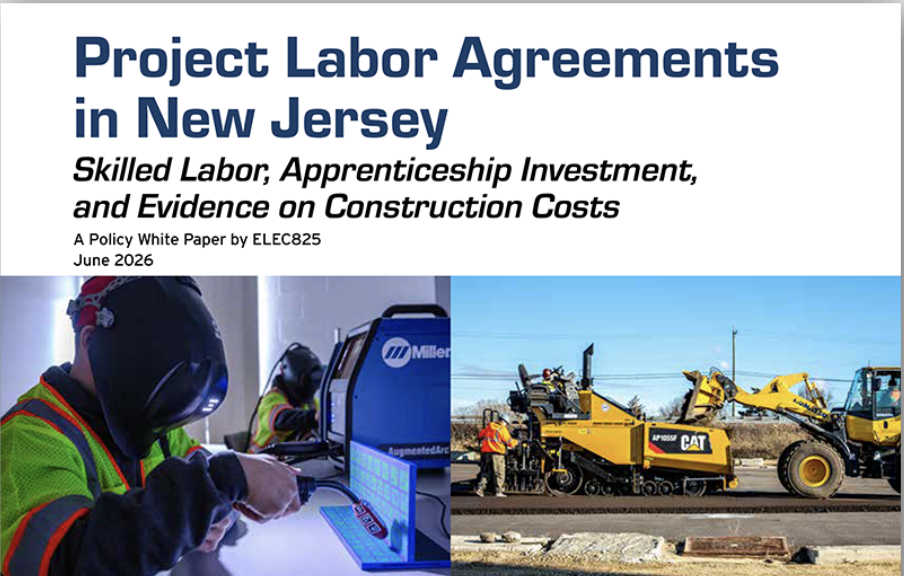
The 2026 white paper, Project Labor Agreements in New Jersey: Skilled Labor, Apprenticeship Investment, and Evidence on Construction Costs, was authored by Peter Philips, a professor of economics at the University of Utah whose research specializes in the construction industry, and Kevin Conner, a labor economist and postdoctoral researcher at the University of Utah. The study examines New Jersey’s construction workforce, apprenticeship investment and the evidence surrounding the cost and performance of projects built under PLAs.
The report’s central conclusion debunks long-standing and misinformed criticisms of Project Labor Agreements and concludes that PLAs do not make public construction more expensive.
In fact, the researchers found that the evidence used to claim PLAs are more expensive – particularly a 2010 New Jersey Labor Commissioner study – has significant methodological limitations that lead to a false narrative. When those limitations are addressed, the apparent cost difference between PLA and non-PLA projects becomes substantially smaller and, among the most comparable projects, disappears.